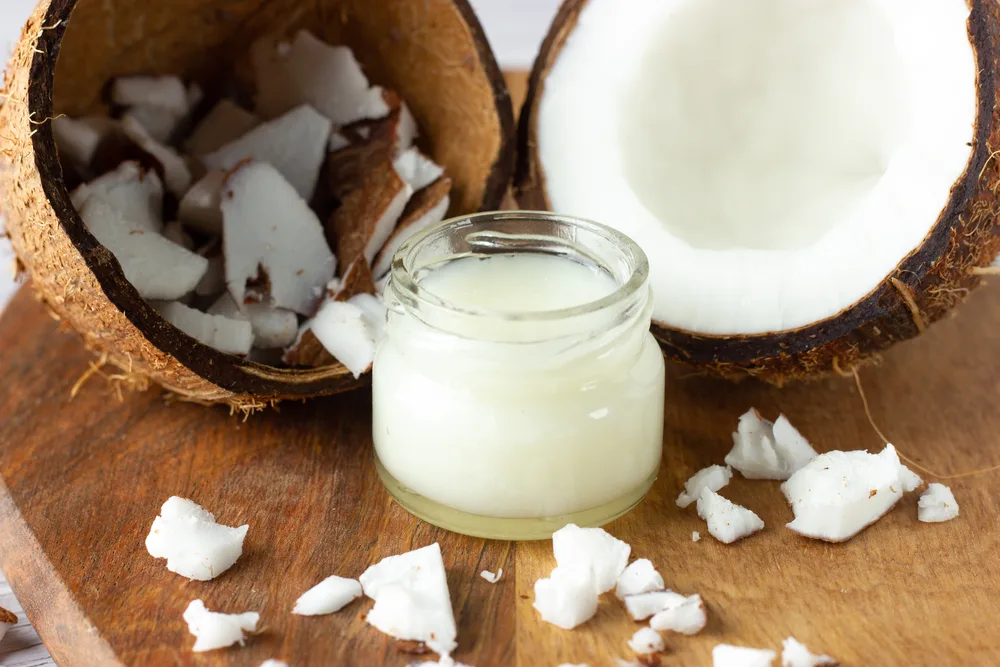
Coconut oil has had an interesting history when it comes to how “healthy” it’s considered. For a long stretch, it was something to limit—grouped in with other saturated fats and linked to heart health concerns. Then came the low-carb and keto wave, and it quickly flipped from avoid to embrace, showing up everywhere from coffee to smoothies as a supposed metabolism booster.
If that back-and-forth feels a little confusing, that’s because the story isn’t all one thing. Coconut oil does have some unique traits—mainly its MCT (medium-chain triglyceride) content, which your body processes differently than many other fats. But it’s also calorie-dense with about 121 calories per tablespoon and little protein, fiber, or micronutrients to help with fullness.
So, where does it land for weight loss? Somewhere in the middle. It can fit, but it’s not doing the work for you. Think of it as a cooking fat—not a strategy—and something that works best when you’re using it with intention. Here’s how to think about it.
✅ Quick answer
It depends, mostly on how much you use. Coconut oil isn’t a weight-loss food on its own, and the research on it as a supplement doesn’t hold up. But used in small, measured amounts as a cooking fat, it can fit comfortably into a lower-calorie eating plan.
🚀 Weight-loss benefits
- It’s a practical butter replacement in baking and cooking – Swapping it for butter or shortening shifts the fat profile slightly toward plant-based fats, and for vegan bakers, its texture makes it the most functional dairy-free substitute on the shelf.
- Fat slows digestion and supports fullness – Meals cooked in coconut oil can leave you feeling satisfied longer because fat slows gastric emptying. This isn’t unique to coconut oil—any fat does this.
- The MCT content may give your metabolism a small nudge – Coconut oil gets roughly 65% of its fat from MCTs, which bypass normal fat digestion and go straight to the liver to be used as energy. Some research suggests this can slightly increase energy expenditure but not dramatically.
⚠️ Things to be mindful of:
- It’s extremely calorie-dense – At 121 calories per tablespoon and zero protein, fiber, or carbohydrates, coconut oil is high in calories and low in nutrients. That’s fine in the right context, but it means there’s no satiety payoff unless it’s paired with a meal that has actual substance.
- It raises LDL cholesterol – This is where the science is clear. Coconut oil significantly increases LDL (“bad”) cholesterol compared to most vegetable oils, largely because its dominant fatty acid behaves more like a long-chain saturated fat in the body. If you have cardiovascular risk factors, this matters.
- It’s easy to use too much – Because coconut oil is solid at room temperature and scoopable, it’s very easy to use far more than you realize. A heaping tablespoon can hit 150 to 180 calories before the rest of your meal is factored in. Measuring rather than scooping freely is the single most important habit to build when cooking with it.
🥗 Nutrients in coconut oil (per 1 tablespoon / 14g)
| Nutrient | Amount | % RDA* |
|---|---|---|
| Calories | 121 calories | 6% |
| Protein | 0 g | 0% |
| Total carbs | 0 g | 0% |
| Fiber | 0 g | 0% |
| Sugars | 0 g | — |
| Total fat | 13.5 g | 17% |
| – Saturated fat | 11.2 g | 56% |
| – Monounsaturated fat | 0.8 g | — |
| – Polyunsaturated fat | 0.2 g | — |
| Omega-3 | 0 g | — |
| Omega-6 | 0.2 g | — |
*Recommended dietary allowance (RDA) is defined as the average daily amount of nutrients needed to meet the requirements of nearly all healthy people in a specific group.
Coconut oil is essentially 100% fat—no protein, no carbs, no fiber, no water. One tablespoon delivers 121 calories and 56% of the recommended daily limit for saturated fat. That’s more saturated fat per tablespoon than butter.
The fat profile is almost entirely saturated, dominated by lauric acid. While lauric acid is technically classified as a medium-chain fatty acid, its behavior in the body is closer to long-chain saturated fats, which is why coconut oil’s MCT reputation is somewhat overstated compared to purified MCT oil. There are no vitamins, no minerals, no antioxidants worth noting. Coconut oil is a cooking fat, and it should be treated as a calorie source first.
💊 Vitamins & minerals in coconut oil (per 1 tablespoon / 14g)
| Vitamin/Mineral | Amount | % RDA* |
|---|---|---|
| Vitamin E | 0.02 mg | <1% |
| Vitamin K | 0.1 µg | <1% |
| Iron | 0.01 mg | <1% |
| Choline | 0.04 mg | <1% |
Coconut oil is not a meaningful source of vitamins or minerals. The trace amounts of vitamin E and vitamin K present contribute essentially nothing to your daily needs. Unlike extra-virgin olive oil, which provides modest vitamin E and polyphenols, coconut oil offers very little beyond its fatty acid profile.
You shouldn’t expect it to deliver lots of vitamins and minerals. It does its job as a heat-stable cooking fat with a distinctive flavor. If you’re looking for a cooking fat with a few vitamins, extra-virgin olive oil is a significantly stronger option.
🔍 Nutrient breakdown
Glycemic index (GI) of coconut oil
Glycemic index: 0 (None—pure fat contains no carbohydrates)
💡 Tip: Pure fats have no GI because they don’t raise blood sugar directly. Coconut oil can actually be useful alongside higher-carb meals to slow digestion and blunt glucose spikes.
Is coconut oil high in protein?
❌ No – coconut oil contains 0g of protein per tablespoon. It’s a pure fat with no amino acids to offer.
Better protein alternatives: Greek yogurt | Eggs | Chicken breast
Is coconut oil high in fiber?
❌ No – coconut oil has 0g of fiber per tablespoon. It’s a refined fat with no plant structure remaining.
💡 Tip: Pair coconut oil-cooked meals with vegetables, legumes, or whole grains to make sure you’re still hitting your daily fiber goals.

See if your insurance
covers GLP-1s.
The form only takes 2 minutes to answer. We’ll handle the rest.
GET STARTEDIs coconut oil low in carbs?
✅ Yes – coconut oil has 0g of carbs per tablespoon, which is one reason it’s popular in keto circles. That said, being carb-free doesn’t make it weight-loss-friendly on its own—the calories still count.
💡 Tip: On a low-carb diet, coconut oil is a useful fat source, but portion control matters just as much as carb restriction.
Is coconut oil gluten-free?
✅ Yes – coconut oil is naturally gluten-free. It’s a pure plant-based fat with no grain proteins involved at any stage of production, making it safe for people with celiac disease or gluten sensitivity.
Is coconut oil good for fat loss?
⚠️ Maybe, in very small amounts – coconut oil isn’t inherently helpful for fat loss given its high calorie density and absence of protein and fiber. But using a teaspoon instead of a tablespoon, or swapping it for a less useful fat, can make it work within a calorie deficit.
💡 Tip: Treat coconut oil like any other cooking fat—measure it rather than eyeballing it. One teaspoon (about 40 calories) goes a long way in a hot pan.
🍽️ Diet compatibility: Which diets include coconut oil?
| Diet | ✅/❌ | Why |
|---|---|---|
| Keto | ✅ | Coconut oil is a go-to fat in keto eating. Zero carbs, high in MCTs, and stable at cooking temperatures make it one of the most-used fats in ketogenic meal plans. |
| Paleo | ✅ | Coconut oil is considered a whole-food-derived fat in paleo eating and has been used in tropical cultures for generations. It fits the no-refined-seed-oils framework of paleo well. |
| Mediterranean | ⚠️ | Technically allowed, but olive oil is the cornerstone fat of the Mediterranean diet for good reason. Using coconut oil occasionally is fine; replacing olive oil with it regularly would shift your fat profile in a less heart-favorable direction. |
| Vegan | ✅ | Coconut oil is entirely plant-derived. It’s a popular butter alternative in vegan baking and cooking, giving baked goods the richness and texture that animal fats typically provide. |
| Gluten-free | ✅ | Naturally gluten-free—no concerns for anyone following a gluten-free diet due to celiac disease or sensitivity. |
Coconut oil is compatible with a wide range of eating patterns, which explains much of its popularity. It fits keto seamlessly, works well with paleo principles, and gives vegan bakers the fat they need to replicate buttery textures.
The one caveat worth noting is the Mediterranean diet comparison. The research behind that eating pattern’s heart health benefits is closely tied to olive oil and its polyphenol content—something coconut oil doesn’t replicate. Using coconut oil as an occasional, flavor-forward addition is fine; using it as your primary cooking fat is a different story. For most people, the smartest approach is to keep coconut oil as one fat among several in a varied pantry.
🌟 Is coconut oil healthy? What are the health benefits?
Metabolic health: Is coconut oil good for your metabolism?
- Boosts metabolism? ⚠️ Modestly, possibly – The MCTs in coconut oil are metabolized more quickly than long-chain fats, and some studies suggest this may produce a small increase in energy expenditure. The effect is modest, though, and doesn’t translate to meaningful fat loss in most clinical trials.
- Improves insulin sensitivity? ⚠️ Possibly, limited evidence – Small studies suggest MCTs may support insulin sensitivity, but much of the research was done with purified MCT oil—not coconut oil specifically—and more human trials are needed.
- Effect on fat storage? Neutral to slightly favorable – Because MCTs are oxidized for energy rather than stored, they’re theoretically less likely to end up as body fat—but only if they’re not contributing to an overall calorie surplus.
Cholesterol impact: Does coconut oil affect cholesterol levels?
- Does it lower LDL (bad) cholesterol? ❌ No – Coconut oil may significantly increase LDL cholesterol compared to most vegetable oils. It’s not as favorable as olive, canola, or sunflower oil.
- Does it raise HDL (good) cholesterol? ✅ Yes – Lauric acid raises both total and LDL cholesterol, but it also increases HDL (“good”) cholesterol. Whether that HDL boost meaningfully offsets the LDL rise is still debated.
- Overall impact on heart health? Mixed – Evidence from randomized controlled trials suggests coconut oil is less damaging to LDL than butter, but less favorable than unsaturated vegetable oils. For heart health, extra-virgin olive oil remains the better bet.
💡 Tip: If you’re managing cholesterol, use coconut oil sparingly and make sure the rest of your fat intake leans on unsaturated sources—avocado, olive oil, nuts, and fatty fish.
Can I eat coconut oil in a calorie deficit?
✅ Yes, with an understanding of what it contributes: Coconut oil can absolutely be part of a lower-calorie eating plan, but at 121 calories per tablespoon, it takes up a significant portion of your fat budget quickly. The key is measuring rather than free-pouring.
💡 Tip: Use a teaspoon instead of a tablespoon when sautéing—you’ll barely notice the difference in the pan, but you’ll save about 80 calories per meal.
Is coconut oil rich in antioxidants?
❌ Minimally: Refined coconut oil has almost no antioxidant activity. Virgin (unrefined) coconut oil retains small amounts of polyphenols and tocopherols, but the amounts are modest compared to olive oil or avocado oil. It’s not a meaningful antioxidant source.
Does coconut oil support gut health?
⚠️ Possibly, modestly: Lauric acid has some antimicrobial properties and may help inhibit harmful gut bacteria, but the human evidence is limited and mostly preliminary. Don’t rely on coconut oil as a gut health strategy on its own.
Does coconut oil support digestion?
Neutral to positive: Fat slows gastric emptying, which can help you feel full longer and moderate blood sugar response after a meal—but that’s true of any fat, not coconut oil specifically.
💡 Tip: If you’re prone to digestive sensitivity, start with small amounts and avoid adding coconut oil to coffee or smoothies on an empty stomach. Some people experience discomfort when introducing MCT-heavy fats too quickly.
Does coconut oil help you feel satiated and less hungry?
Low to moderate: Fat slows digestion and extends the time before hunger returns, and coconut oil contributes to that effect—but it’s not notably more filling than other fats calorie-for-calorie.
Satiety level: Low to Moderate
💡 Tip: For better satiety, pair coconut oil-cooked meals with plenty of protein and fiber—those two nutrients do far more of the fullness work.
Does coconut oil help with nighttime cravings?
⚠️ Indirectly: If your dinner includes a small amount of coconut oil alongside protein and fiber, the fat component can help you feel satisfied through the evening. Coconut oil alone isn’t a craving solution.
💡 Tip: Build your evening meal around protein and vegetables first, then use coconut oil as the cooking fat rather than relying on it to manage cravings on its own.
Does coconut oil help reduce inflammation?
⚠️ Possibly, modestly: Virgin coconut oil contains small amounts of polyphenols, and lauric acid has shown some anti-inflammatory activity in lab studies. The evidence in humans is limited and the effect is modest at best.
Access GLP-1 Weight Loss with Noom
Explore a wide range of prescription medications supported by Noom’s program.Microdose GLP-1rx
Noom GLP-1rx
Noom GLP-1rx Plus
Wegovy®
Ozempic®

Metformin
Zepbound®
Mounjaro®
Liraglutide

Is coconut oil beneficial for brain health?
⚠️ Limited evidence in healthy adults: MCTs can be converted to ketones, which serve as an alternative fuel for the brain. This has generated some interest in Alzheimer’s research, but clinical evidence in otherwise healthy adults isn’t strong enough to make firm claims.
Can coconut oil improve skin and hair health?
✅ Yes – topically: This is probably coconut oil’s most well-supported use. Applied directly, it’s an effective moisturizer and has been shown to reduce protein loss in hair. Its dietary impact on skin is less studied.
Can coconut oil help balance hormones?
❌ Not significantly: Adequate fat intake in general supports hormone production, but coconut oil doesn’t have any specific hormonal advantage over other dietary fats.
💡 Tip: Focus on getting a variety of healthy fats—olive oil, avocados, nuts, fatty fish—rather than relying on any single fat source for hormonal health.
🍽️ Best ways to use coconut oil for weight loss
- Use it as a measured cooking fat – Coconut oil’s relatively high smoke point (up to 400°F for refined) makes it genuinely useful for sautéing, roasting, and stir-frying. The key is measured: use a teaspoon to a tablespoon. When it replaces butter in baking or cooking, it’s a reasonable swap.
- Choose virgin coconut oil for cold or low-heat applications – Unrefined virgin coconut oil retains more of its polyphenols and natural coconut flavor. Use it in smoothies, energy balls, or drizzled lightly over a dish where you want that coconut note. Keeping it unheated preserves what limited antioxidant content it has.
- Skip the supplement approach – Adding tablespoons of coconut oil to your coffee or smoothies in the hope of boosting metabolism is where the hype outpaces the science. Studies have found no clinically significant effects of coconut oil supplementation on weight, BMI, or waist circumference. At 120+ calories per tablespoon, using it liberally as a supplement can easily work against a calorie deficit rather than for it.
National Coconut Oil Day is June 26. Try these healthy coconut oil recipes:
- Healthy Granola — Love & Lemons
- Spring Veggie Stir-Fry — Cookie and Kate
- Instant Pot Curried Lentil Soup — Minimalist Baker
🍏 Best alternatives & comparisons (per 1 tablespoon / 14g)
| Food | Calories | Carbs | Fiber | Protein | Fat |
|---|---|---|---|---|---|
| Coconut oil | 121 | 0 g | 0 g | 0 g | 13.5 g |
| Extra-virgin olive oil | 119 | 0 g | 0 g | 0 g | 13.5 g |
| Avocado oil | 124 | 0 g | 0 g | 0 g | 14 g |
| Butter | 102 | 0 g | 0 g | 0.1 g | 11.5 g |
| Ghee | 112 | 0 g | 0 g | 0 g | 12.7 g |
| Canola oil | 124 | 0 g | 0 g | 0 g | 14 g |
Calorie-wise, cooking oils are all remarkably similar—the differences between coconut oil, olive oil, and avocado oil amount to just a few calories per tablespoon. Where they differ significantly is in fat quality, flavor, and health implications.
Extra-virgin olive oil is the most evidence-backed option for heart health and contains polyphenols, vitamin E, and oleic acid that coconut oil doesn’t. Avocado oil shares a similar fat profile to olive oil with a higher smoke point, making it excellent for high-heat cooking. Canola oil is the lowest in saturated fat of all options listed, making it a strong choice for people actively managing cholesterol. For vegan bakers or those avoiding dairy, coconut oil’s texture makes it the most functional butter replacement—but for overall health benefit, olive oil or avocado oil pull ahead.
Frequently asked questions about coconut oil and weight loss
Is coconut oil actually good for weight loss?
Not on its own—and the evidence doesn’t support using it as a weight-loss supplement. A 2025 meta-analysis of 15 clinical trials found no clinically significant effects of coconut oil supplementation on body weight, BMI, or waist circumference. That said, used in small measured amounts as a cooking fat, it can fit comfortably into a calorie-deficit eating plan.
How much coconut oil should I use per day if I’m trying to lose weight?
Stick to 1–2 teaspoons to 1 tablespoon per day, and count those calories. One tablespoon is 121 calories of pure fat, so if you’re using coconut oil multiple times a day without tracking it, those calories add up fast. Measure rather than eyeball.
Is coconut oil better than olive oil for weight loss?
They’re nearly identical in calories per tablespoon, but extra-virgin olive oil has a stronger nutritional profile overall—more polyphenols, vitamin E, and oleic acid, with a better track record for heart health in the research. For weight-loss purposes, the oil you use matters much less than how much of it you use.
Does coconut oil boost metabolism?
Slightly and temporarily, maybe. Coconut oil’s MCTs are metabolized more quickly than long-chain fats, which may produce a small increase in energy expenditure. The metabolism-boosting reputation is largely borrowed from purified MCT oil research, which isn’t the same thing as coconut oil.
Is coconut oil bad for your heart?
It’s complicated. Coconut oil raises LDL (“bad”) cholesterol compared to most vegetable oils—a real consideration for heart health. It also raises HDL (“good”) cholesterol, but whether that offset is meaningful is still debated. The American Heart Association recommends limiting coconut oil if heart health is a concern and favoring unsaturated oils like olive or canola instead.
Can I use coconut oil on a keto diet?
Yes—coconut oil is a natural fit for keto. It’s carb-free, high in MCTs, and heat-stable. Some keto followers add it to coffee or smoothies for extra fat, though those calories count toward your daily total just like any other food.
Why does coconut oil have such a strong health reputation if the science is mixed?
A lot of the enthusiasm came from MCT oil research—which does show some interesting metabolic effects—being applied to coconut oil, which isn’t the same thing. Purified MCT oil has a different composition than coconut oil, and the two aren’t interchangeable. Media coverage ran ahead of the actual evidence, and coconut oil’s popularity in paleo and keto communities did the rest.
🧠 The bottom line: Coconut oil can be part of a weight-loss approach in measured amounts
Coconut oil is a legitimate cooking fat with a place in a balanced diet—but the weight-loss hype hasn’t held up well under scientific scrutiny. Adding tablespoons to your coffee won’t speed up fat loss, and using it freely as a “health food” can easily add hundreds of unplanned calories to your day.
What coconut oil does well: it handles heat, it replaces butter in vegan cooking, it has a distinctive flavor, and its MCTs are processed a bit differently than other saturated fats. What it doesn’t do: deliver meaningful vitamins or minerals, significantly boost metabolism, or justify using more than a teaspoon or tablespoon at a time.
Used in measured amounts as one of several cooking fats in a varied diet, coconut oil fits comfortably into a weight-loss approach. Measure it, don’t pour it freely, and skip the mythology. If you’re looking for a sustainable way to build eating habits that actually hold up, Noom’s program is built around exactly that kind of practical, evidence-based thinking.
See if your insurance
covers GLP-1s.
The form only takes 2 minutes to answer. We’ll handle the rest.
GET STARTED📖 Scientific evidence
1.Coconut oil supplementation has no clinically significant effect on body weight. (BMC Nutrition, 2025) An analysis of 15 clinical trials found that coconut oil supplementation produced no meaningful effects on body weight, BMI, or waist circumference.
2. Coconut oil raises LDL and HDL cholesterol compared to vegetable oils. (Circulation / American Heart Association Journals, 2020) A meta-analysis found that coconut oil significantly increases both LDL and HDL cholesterol compared to non-tropical vegetable oils, with no significant effect on triglycerides, body weight, or body fat.
3. MCT research doesn’t transfer directly to coconut oil. (European Journal of Clinical Nutrition, 2017) A review found a lack of consistent evidence linking coconut oil specifically to satiety or weight loss, noting that media claims had largely been based on purified MCT oil research—a different compound—rather than coconut oil studies.
4. Replacing coconut oil with unsaturated fats lowers cardiovascular risk markers. (Current Atherosclerosis Reports, 2023) A review found that replacing unsaturated vegetable oils with coconut oil raises total and LDL cholesterol, and that claims about coconut oil being uniquely beneficial for heart health are not supported by the available evidence.
5. Coconut oil alongside a balanced diet may support modest metabolic improvements. (Food & Function, RSC Publishing, 2020) A randomized controlled trial found that daily coconut oil consumption alongside a balanced diet appeared to support modest improvements in weight and metabolic parameters in men with obesity.
Editorial standards
At Noom, we’re committed to providing health information that’s grounded in reliable science and expert review. Our content is created with the support of qualified professionals and based on well-established research from trusted medical and scientific organizations. Learn more about the experts behind our content on our Health Expert Team page.